
AI in Software Development: Innovation vs resistance
Management expectations versus developer reality.

Last year I attended a conference, and one presentation stayed with me.
Not because I had all the answers afterwards.
But because it put words and data around a tension many Tech Leads are already feeling.
What follows is not my expert opinion.
The promises being made about AI in Software Development
According to McKinsey & Company, generative AI can increase developer speed by roughly 36% to 45%.
Bain & Company reports that engineering organisations using generative AI tools see average efficiency gains of around 10% to 15%.
Research from IT Revolution suggests that AI-powered coding assistants can increase developer productivity by about 26% in real-world enterprise environments.
The 2024 Stack Overflow Developer Survey reports that more than 80% of developers say AI tools improve their productivity.
Taken together, these numbers create a strong narrative.
AI will make teams faster.
AI will make teams more efficient.
AI will pay off quickly.
Management expectations versus developer reality
From a management perspective, the expectation often looks like this:
AI tools are introduced. Within a few weeks, teams are expected to see a clear efficiency boost, sometimes in the range of 15% or more.
On the developer side, the reactions are more mixed:
Enthusiasm and curiosity, alongside skepticism and concern.
Common concerns:
Impact on code quality.
Loss of control over what ends up in production.
Relevance and usefulness of AI-generated suggestions for complex, existing codebases.
The additional effort required to review, validate, and sometimes undo AI-generated code.
AI is not a developer
AI is not a developer, it’s a developer’s assistant.
When AI is treated as a replacement, resistance increases.
When it is treated as an assistant, learning and experimentation become possible.
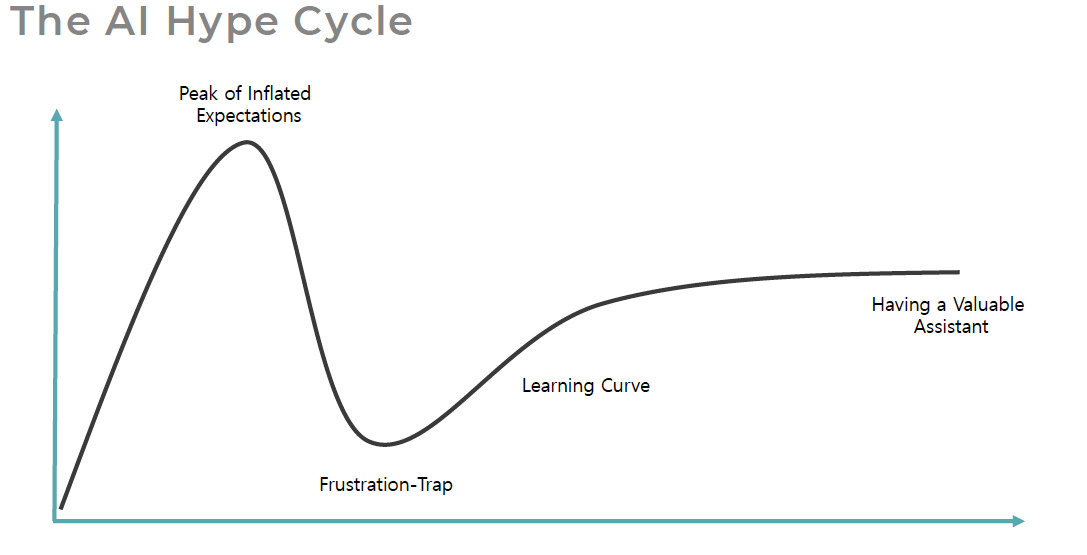
AI adoption in Software Development teams
A secure environment and time and space for experimentation makes the difference. Failure is an integral aspect of the journey.
Tool selection is critical and it‘s ok to course-correct.
Takeaways:
Faster code generation – up to 46% by auto-suggestions (GitHub)
67% shorter code review cycles (IBM)
30-50% faster test creation and execution (Mc Kinsey)
20% less time spent on documentation (Gartner)
Regardless of the tools involved, the developer remains accountable for the code.
AI can assist.
AI can accelerate.
AI does not take responsibility.
As a Tech Lead, the questions is “How do you hold the space between expectations and reality while teams learn?”
I am still sitting with that question.
I believe in you,
Andra
Whenever you’re ready, here are a few ways in which I can help you:
Create 2026 — 1:1 Strategy Session
Design 2026 with clarity and intention. A 2h 1:1 session to: define your 2026 goals, identify what may block you and create a realistic plan to achieve them. You leave with your 2026 vision and a clear path to follow.€250 → €150 Offer ends 1 February. Book here.
Tech Lead Accelerator
Build the skills your Tech Lead role requires. Communication. Boundaries. Delegation. Empowering people. 5 x 75-minute 1:1 sessions and ongoing support to help you lead with clarity, instead of overwhelm.€800 → €600 Offer ends 1 February. Details here.
1:1 FREE coaching call
A focused session on the challenges you are dealing with right now. You will get clarity, direction, and an experience of what working together feels like.
Available to those who have not had a 1:1 session with me before.
FREE. Book here.